How IP and centralized control power the Pacers’ game-day advantage

- 08 April 2026
Operating out of Gainbridge Fieldhouse in downtown Indianapolis, with seating for up to 18,000 fans, PSE manages a demanding, year-round schedule that includes Big Ten basketball tournaments, concerts, comedy shows, major live events, as well as private functions.
To support these productions, PSE operates a permanent, in-house live production facility. From this control room, the team produces all in-venue content for the arena’s LED displays, delivering live camera feeds, replays, roll-ins, and custom elements that help define the game-day experience for fans inside the building and across multiple venues.
Designed with scalability in mind, this production infrastructure now extends beyond a single venue. Since 2026, PSE has leveraged it to connect and support its G-League team’s new home, The Arena at Innovation Mile, enabling shared resources and consistent production across locations.
In 2023, a major renovation of Gainbridge Fieldhouse gave PSE the opportunity to fundamentally rethink how its production organization operates. Rather than swapping out legacy systems piece by piece, much of the existing infrastructure was removed, physical spaces were redesigned, and the production environment was rebuilt almost entirely from scratch. All of this while the venue continued to host a demanding calendar of live events.
One of the biggest challenges was modernizing the routing and control environment. The team needed a solution built around an IP-based core that would ensure a controlled, low-risk transition without jeopardizing game-day operations.
At the same time, expectations for quality in-venue content continued to rise. Fans, teams, and sponsors all expected higher production value, and stronger storytelling on the arena’s LED screens across NBA, WNBA, and other events each with their own distinct production demands.
Efficiency was another major factor. With frequent event changeovers, and a team that spans engineering and non-engineering profiles, the production environment needed to become easier to operate, with more automation and fewer opportunities for human error.
Because PSE was planning for a multi-venue future, the new architecture also needed to support centralized and remote production workflows. This meant integrating equipment from multiple vendors into a unified system that could scale beyond a single control room and enable distributed operations without adding complexity.
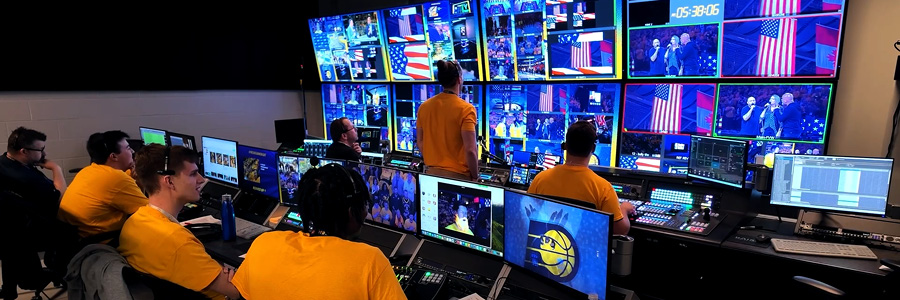
“When we started evaluating IP, we didn’t just look at who technically supports 2110. We wanted to know who’s really doing it well, and who’s going to support us not just next year, but ten years from now, because we don’t get many chances to rebuild systems like this.”
The renovation created an opportunity to rethink how the entire production ecosystem operates, making it more connected, more scalable, and more cost-efficient over time. The team carefully balanced upfront investment with long-term operational sustainability, ensuring today’s decisions would support tomorrow’s growth.
PSE rebuilt its production environment around a flexible, IP-first architecture which combined EVS’s live production and replay, media asset management, and media infrastructure solutions for IP bridging, signal processing and broadcast control. A key objective was to make IP operationally invisible to operators, while delivering ultra-low latency, frame-accurate performance and seamless workflows, without adding complexity.
At the operational core sits Cerebrum, EVS’s broadcast control and orchestration system. Rather than managing cameras, audio, replay, graphics, routing, and facility systems as separate silos, Cerebrum provides a single interface that orchestrates the entire production environment. It creates a unified layer that also allows seamless integration of best-of-breed technologies from multiple manufacturers, including cameras, teleprompters, returns, and multiviewers, without requiring operators to switch between programs or interfaces.
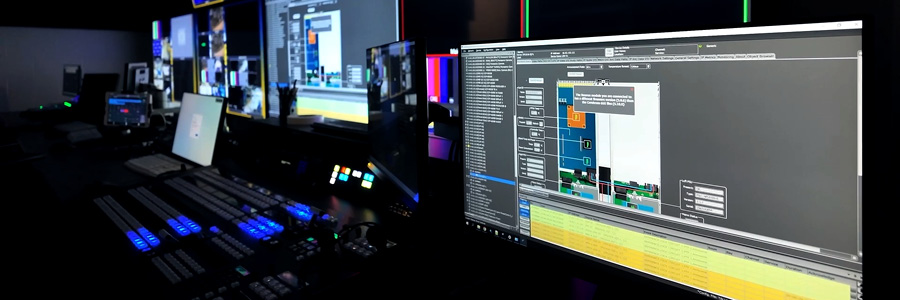
"When we first installed Cerebrum, we thought it was just router control. But we quickly came to find that it is so much more; it has enabled us to further optimize our operations, controlling all devices, and serving multiple venues from one central place."
Within this architecture, EVS Neuron serves as the IP gateway and processing layer, bridging SDI and IP domains, and converting signals as needed.
Crucially, this complexity remains invisible to operators. They continue using familiar workflows, while Cerebrum handles the underlying orchestration, monitoring, and automation. Production staff can focus entirely on storytelling and execution rather than troubleshooting infrastructure.
The platform also supports deep customization. The team designed tailored control panels to simplify audio routing within Neuron, making routine tasks faster and more intuitive. Directors can update labels and mnemonics through a web interface, with changes reflected instantly across UMDs and control panels.
On the replay side, PSE upgraded to EVS LSM-VIA remotes, enabling faster workflows and greater creative flexibility. And with the addition of XtraMotion, the team has access to powerful tools to enhance replays and create visually striking content with AI-generated special effects.
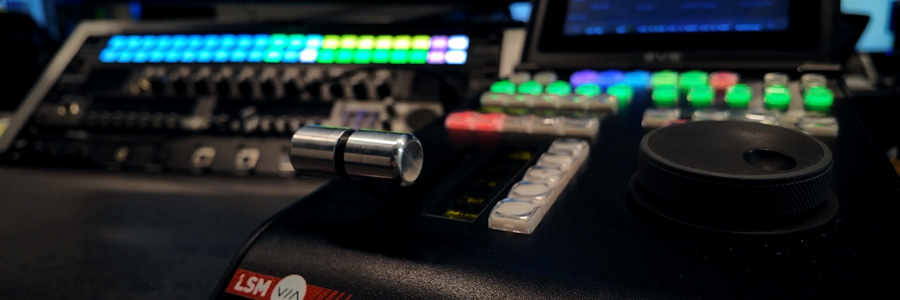
“We use XtraMotion mainly for roll-ins, bumps, and building packages. We can feed it anything: live shots, clipped moments, even older footage, and turn it into something more artistic. It’s really expanded our storytelling toolkit, which is something we’re putting a lot of focus on for the fan experience.”
In 2026, PSE extended its production capabilities to include its G-League team’s new venue, The Arena at Innovation Mile. Instead of building a separate control room, the organization leveraged its existing infrastructure and Cerebrum’s orchestration capabilities to connect both venues.
This approach enables centralized, remote production of games and fan engagement content, reducing costs while maintaining consistent quality. Cerebrum allows teams at both locations to operate as a single, unified unit. With tools like Salvos, event configurations can be deployed quickly, further streamlining multi-venue operations.
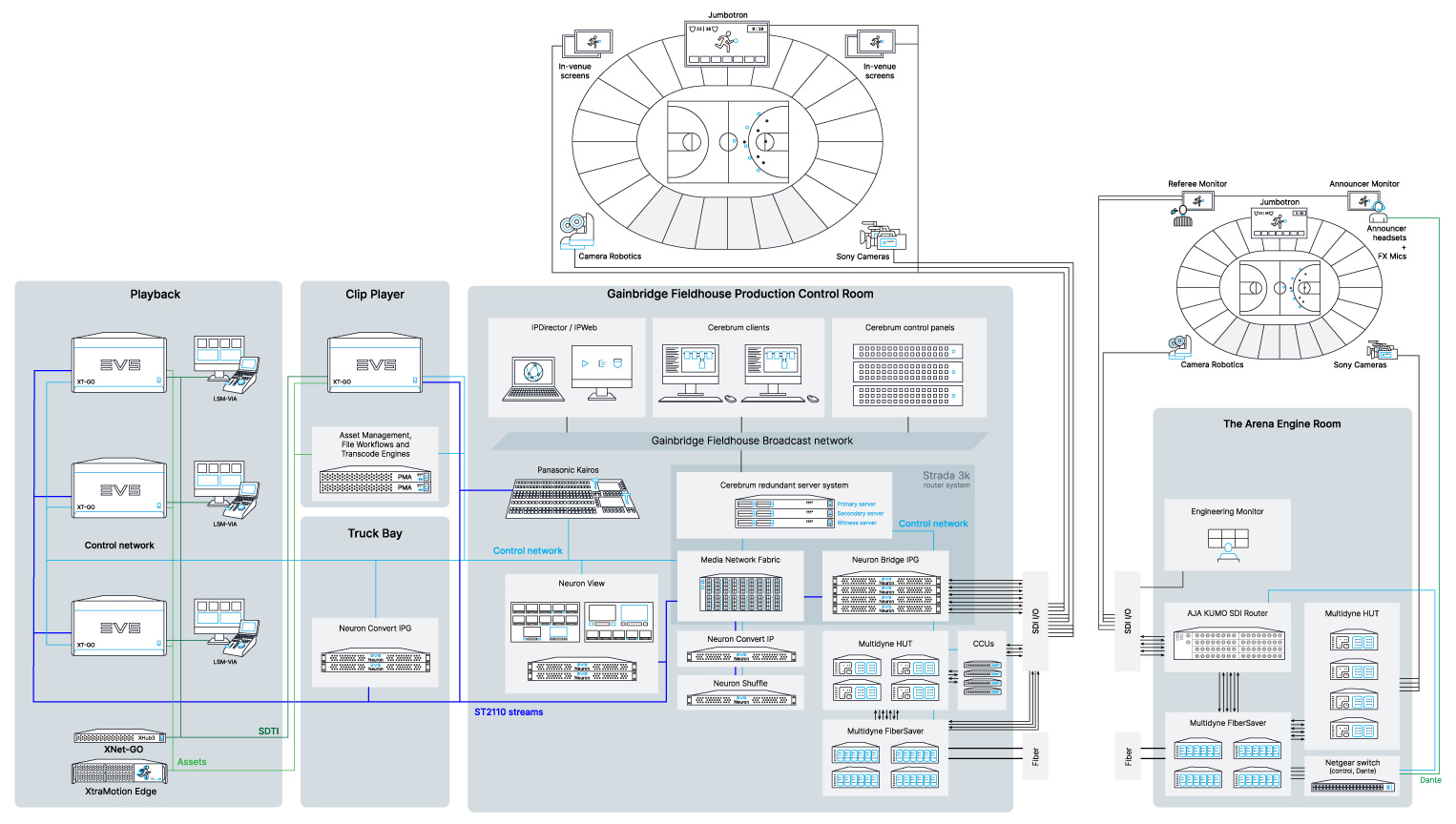
Click on the diagram to open it in full size
-

A practical and scalable IP architecture
The Pacers Sports entities operate on a modern IP-first production core that integrates seamlessly with baseband systems at the edge. Familiar workflows stay intact; game-day operations continue without disruption, and production staff can operate across multiple venues while drawing on centralized, pooled resources through a single intuitive interface.
-

Ultra-low latency production
The architecture delivers extremely low latency, enabling frame-accurate replay, intercom, camera shading, and commentary. Scoreboards, clocks, and video feeds remain perfectly synchronized, eliminating the compromises typically associated with REMI and remote production models.
-

A system that scales as the venue evolves
As production needs grow, the infrastructure can grow alongside them. Additional XT servers, operator positions, and Neuron processors can be added without reworking the overall design, allowing the team to expand capabilities while protecting their original investment.
-

Unified visibility and control
Instead of navigating multiple systems, the team now works from a single, customizable interface. Cerebrum centralizes monitoring, control, labeling, automation, and facility integration in one place – delivering clearer oversight and enabling faster decision-making.
-

Faster, more reliable event setup
Cerebrum Salvos allow complex system changes to be executed with a single click. Preparing for an event now means adjusting router paths, server settings, and multiviewer configurations all at once, significantly reducing setup time and lowering the risk of human error.
-

Elevated production quality
The transition to LSM-VIA was swift, with operators quickly adopting advanced features. Combined with XtraMotion’s AI-powered enhancements, the team can deliver visually striking, premium-quality replays that enhance the in-venue experience and strengthen competitive positioning.
With EVS at the core of its IP production infrastructure, Pacers Sports & Entertainment now operates a flexible, interoperable platform that meets today’s demands while supporting future growth.
From Gainbridge Fieldhouse to the Arena at Innovation Mile, PSE delivers consistent, high-quality productions across multiple venues. The system serves as a blueprint for how a sports and entertainment organization can leverage IP, automation, and orchestration to improve operational efficiency, unlock new production capabilities, and elevate the fan experience.


